Source Cordless Telescopic Electric Pruning Shears for Gardens, Farms, and Orchards
Explore 30 listings of cordless telescopic electric pruning shears with varying voltage, battery capacity, and cutting diameters. Buyers can compare ratchet and anvil types, power outputs from 300W to 1050W, and charging times to find suitable tools for professional landscaping and agricultural use.
Key considerations
Products List



Comprehensive Sourcing Guide
Strategic Sourcing Guide for Cordless Telescopic Electric Pruning Shears
Understanding the Technical Landscape of Electric Pruning Systems
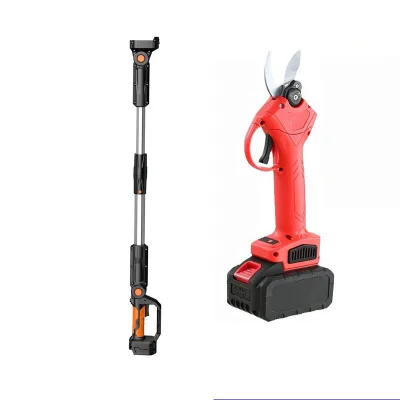
The procurement of cordless telescopic electric pruning shears requires a precise understanding of the diverse technical configurations available in the current B2B market. Unlike manual tools, these systems integrate complex powertrain components, battery management systems, and mechanical linkages designed for extended reach and high-torque cutting. Based on observed market data, buyers must navigate a spectrum of power specifications that directly influence operational capability. The voltage requirements for these tools vary significantly, with observed specifications ranging from 21V to 380V. A 21V system, often paired with a 2Ah battery capacity, typically offers a working time of 2 to 3 hours and a charging duration of 1.5 to 2 hours, suitable for light to medium-duty residential or commercial landscaping. Conversely, higher voltage inputs such as 380V suggest industrial-grade applications or specific power supply configurations that may require distinct infrastructure.
The power output is another critical differentiator. Market observations indicate power ratings spanning from 300W to 1050W. A 300W unit with two-speed adjustable power offers versatility for delicate trimming, while a 1050W motor provides the necessary torque for thicker branches. The mechanical design also varies; some units feature a ratchet pruner type, which reduces the force required by the operator through a mechanical advantage system, while others utilize an anvil configuration. The blade geometry is equally important, with straight knife shapes being common for general pruning, though specific models may offer beak or elbow shapes to access difficult angles. The cutting capacity, or shear radius, is a definitive metric for branch thickness; observed data points to a shear capacity of up to 120mm, with specific cutting diameters ranging from 25mm to 40mm depending on the model. Buyers must align these technical specifications with the specific vegetation density and branch thickness they intend to manage.
Compliance, Certification, and Safety Standards Verification
In the B2B procurement of electrical gardening equipment, verifying compliance with safety and quality standards is paramount. While specific certification marks were not explicitly detailed in the product listings, the presence of a 1-year warranty suggests a baseline commitment to product durability and manufacturer accountability. When evaluating potential suppliers, buyers must rigorously verify that the electrical components meet international safety standards for portable power tools. This includes checking for proper insulation, overload protection, and battery safety protocols, particularly for lithium-ion systems which are standard in the 21V and 16.8V configurations observed.
The manufacturing origin is a significant factor in compliance. The supplied data indicates that the primary production origin is China, with specific manufacturing hubs noted in Zhejiang province. This geographic concentration implies a mature supply chain but necessitates strict due diligence regarding the specific factory's adherence to export standards. Buyers should request documentation confirming that the tools comply with relevant regional safety directives, such as CE marking for European markets or UL standards for North American markets, even if these are not explicitly listed in the initial product summary. Furthermore, the "Not Coated" finishing process observed in some listings requires verification of material safety, ensuring that the exposed metal components do not pose corrosion risks or chemical hazards during prolonged use. The standard dimensions of 45x35x53 cm for packaging suggest a standardized shipping profile, but buyers must confirm that the product itself meets the dimensional and weight constraints of their specific logistics channels.
Cost Drivers and Pricing Dynamics in the Electric Pruning Sector
The pricing structure for cordless telescopic electric pruning shears is influenced by a combination of material costs, battery technology, and power output. The observed price range in the market spans from 10 USD to 219 USD, a variance that reflects the disparity between basic manual-assist models and fully automated, high-power electric units. The lower end of the spectrum likely corresponds to simpler mechanisms or smaller battery capacities, while the upper end encompasses models with higher wattage (up to 1050W), advanced battery systems, and premium branding such as Makita.
Material composition plays a substantial role in cost. The observed use of plastic handles and a combination of metal and plastic in the standard construction indicates a balance between durability and weight reduction. However, the inclusion of high-capacity batteries, such as the 16.8V/2Ah or 21V/2Ah units, significantly impacts the unit cost. Buyers should note that the "Semiautomatic" automation level observed in some models may also contribute to pricing, as it involves more complex internal gearing and control systems compared to fully manual or purely mechanical ratchet systems. Additionally, the gross product weight of approximately 1043g for certain models suggests a robust build, which correlates with higher material costs.
Minimum Order Quantity (MOQ) is another critical cost driver. The market data reveals an MOQ range from 1 to 500 units. While some suppliers may offer low-volume testing options with an MOQ of 1, bulk procurement often requires an MOQ of 500 units. This high threshold can influence the total landed cost, as buyers must factor in the capital expenditure required to meet the MOQ. The packaging method, ranging from simple boxes to plywood cases and cartons, also affects shipping costs and potential damage rates, which indirectly influences the total cost of ownership.
Typical Applications and Operational Scenarios
The versatility of cordless telescopic electric pruning shears makes them suitable for a wide array of applications, from residential gardening to large-scale agricultural management. The telescopic nature of these tools allows operators to reach high branches without the need for ladders, significantly enhancing safety and efficiency. Models with a cutting diameter of up to 40mm are ideal for pruning fruit trees, ornamental shrubs, and hedges where branches are of moderate thickness. The 120mm shear capacity observed in some high-end models extends the utility to thicker woody stems, making them suitable for orchard maintenance and vineyard management.
The power supply type, whether DC or AC, dictates the operational environment. DC-powered units, typically battery-operated, offer the highest mobility and are preferred for remote locations or areas without easy access to power outlets. The observed working time of 2 to 3 hours on a single charge supports continuous operation for medium-sized properties. In contrast, units requiring 380V power are likely intended for stationary industrial settings or large-scale operations where power infrastructure is readily available. The "Adjust Speed" feature allows operators to modulate the cutting speed based on the material being cut, providing precision for delicate foliage and power for dense wood.
Supplier Evaluation and Sourcing Strategy
When evaluating suppliers for these specialized tools, buyers must look beyond the basic product listing. The presence of customization options, such as "Customized Support: Other" and "Customization: Available," indicates that suppliers are willing to adapt products to specific buyer requirements. This flexibility is crucial for B2B buyers seeking private labeling or specific technical modifications. The "Sea Harbour: Ningbo" specification highlights a key logistical hub, suggesting that many suppliers are located in or near this major port, which can streamline export processes.
Buyers should prioritize suppliers who demonstrate transparency in their production standards and packaging methods. The variation in packing, from "Carton" to "Plywood Case," suggests different levels of protection for the goods. For international shipping, plywood cases may be necessary to prevent damage, while cartons might suffice for domestic distribution. The "Model Number" variations, such as Fbeps-251801, SC-8603, and ymn36, indicate a diverse product portfolio. Buyers should verify that the specific model number corresponds to the exact technical specifications required, as slight variations in model numbers can denote significant differences in power, battery, or blade geometry.
Quality Control and Long-Term Procurement Considerations
Ensuring consistent quality in electric pruning shears requires a robust quality control (QC) protocol. Given the "Not Coated" finishing observed in some products, buyers must implement strict inspection procedures to check for rust, sharp edges, and structural integrity. The "Unfolded" state of the product upon delivery suggests that telescopic mechanisms must be tested for smooth extension and retraction to ensure they do not seize or become loose during use.
Long-term procurement considerations should focus on the availability of spare parts and battery replacement. The warranty period of 1 year is a standard benchmark, but buyers should negotiate extended warranty terms or service level agreements (SLAs) for bulk orders. The battery technology, specifically the 2Ah capacity and charging times, should be evaluated for longevity and cycle life. Suppliers should provide data on battery degradation rates to help buyers estimate the total cost of ownership over the product's lifespan. Additionally, the "Two-Speed Adjustable Power" feature requires regular maintenance of the speed control mechanisms to ensure consistent performance.
Comparative Analysis of Key Product Attributes
To facilitate informed decision-making, the following table summarizes the key technical attributes observed in the market for cordless telescopic electric pruning shears. This comparison highlights the diversity in specifications that buyers must consider when selecting the right tool for their specific needs.
| Attribute Category | Observed Specification Range | Key Variations |
|---|---|---|
| Power Supply Voltage | 21V, 380V | DC vs. AC input requirements |
| Power Output | 300W - 1050W | Low power for light duty vs. high power for thick branches |
| Battery Capacity | 16.8V/2Ah, 21V/2Ah | Affects working time and charging duration |
| Pruner Type | Ratchet, Anvil | Mechanical advantage vs. direct cutting force |
| Blade Shape | Straight Knife, Beak, Elbow | Accessibility and cutting angle variations |
| Cutting Diameter | 25mm - 40mm | Branch thickness capacity |
| Shear Capacity | Up to 120mm | Maximum branch diameter for heavy-duty models |
| Automation Level | Semiautomatic | Degree of motor assistance required |
| Packaging | Box, Carton, Plywood Case | Protection level and shipping efficiency |
| Origin | China (Zhejiang) | Manufacturing hub and logistics considerations |
This comprehensive analysis underscores the importance of aligning technical specifications with operational requirements. By carefully evaluating voltage, power, battery life, and mechanical design, buyers can source cordless telescopic electric pruning shears that deliver optimal performance and value. The diversity in the market allows for tailored solutions, but it also demands rigorous due diligence to ensure that the selected products meet the specific demands of the intended application.
FAQs
What is the voltage range for these pruning shears?
The voltage range spans from 21V to 380V depending on the model. Lower voltage units like 21V are typically battery-operated for mobility, while 380V models suit industrial settings with fixed power infrastructure.
How much power do these electric shears produce?
Power output varies between 300W and 1050W across available models. A 300W unit offers adjustable speeds for light trimming, whereas 1050W motors provide higher torque for cutting thicker branches up to 40mm diameter.
Which pruner types are available in this category?
Available pruner types include ratchet and anvil configurations. Ratchet models reduce operator effort through mechanical advantage, while anvil types offer direct cutting force for specific vegetation density requirements.
Can I find models with specific blade shapes?
Yes, blade shapes include straight knife, beak, and elbow designs. These variations allow access to difficult angles, with straight knives being common for general pruning and beak shapes for specialized trimming tasks.
What is the maximum cutting capacity for these tools?
The maximum shear capacity reaches up to 120mm for heavy-duty models. Specific cutting diameters range from 25mm to 40mm, allowing selection based on the thickness of branches intended for pruning.
How long do the batteries last on a single charge?
Working time typically ranges from 2 to 3 hours on a single charge. Charging durations vary between 1.5 to 2.5 hours depending on the specific battery capacity, such as 16.8V or 21V systems.
What is the minimum order quantity for these shears?
The minimum order quantity ranges from 1 to 500 units depending on the supplier. Some vendors allow low-volume testing with an MOQ of 1, while bulk procurement often requires an MOQ of 500 units.
Where are these products primarily manufactured?
Products are primarily manufactured in China, with specific hubs in Zhejiang province. The sea harbor for shipping is Ningbo, indicating a mature supply chain concentrated in this region for export logistics.